Hamlet history
Our Town's Beginnings -- by Olive Doty, Town Historian
The Hamlets |
|
Pleasant Valley

Then (1895-1910)
(Left to Right) Fireman's Hall, Fitzpatrick's Hotel, The Dainty Little Tea Shoppe/Post Office, Harness Shop, Covered Bridge
Post Card from Dieter Friedrichsen's collection
Now (2002)
Photo by Teddi
What is now the hamlet of Pleasant Valley was in 1762 called Charlotte. At that time it was part of the Crum Elbow Precinct part of the Nine Partners Grant.
The Presbyterian Church was reestablished here in 1765 as the settlers moved west to take advantage of Wappingers Creek for water power. The church was incorporated in 1785 and was known as the Presbyterian Congregation of Pleasant Valley.
Malancton Smith who was a delegate to the Ratification of the U.S. Constitution at the court house in Poughkeepsie was a ruling elder in this church.
In 1788 Pleasant Valley became part of the Town of Clinton when the precincts were divided into townships.
The Methodist Church was originally built in 1827 on a site east of the American Legion Hall. The building was moved in winter to where we see it and recognize it as the Masonic Temple.
St. Paul's Episcopal Church was built in 1842 by people from England who had come to work in the mill.
St. Stanislaus Roman Catholic Church began with services in a barn on the inn property across the street. Originally a small chapel was built on the location where the church now stands. The present building was erected in 1956.
The Quakers built their meeting house on the corner of North Avenue and Quaker Hill Road in 1810. This building is now owned by the Garage.
Amasa Angell was the first postmaster and he was appointed in 1812. Early on postmasters were appointed by the ruling political party, so from 1880 through 1897 the office seasawed between Edward Drake and Wright Devine, both proprietors of general stores.
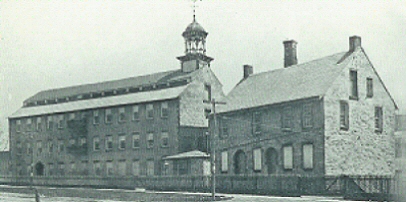
Besides farming the other important early industry was milling. There were grain mills, cotton mills and fulling mills. The one mill to survive was Robert Abbot's cotton and grain mill first built in 1808. It burned and was rebuilt and stands today, a derilict and victim of the times.
The early maps do not show names of roads and changes are they had different names anyhow. The Beers map of 1867 shows six schools in the hamlet as required by law at that time. The one location to survive has had three different buildings and is called Traver Road School.
There were three hotels on the main street. The only building still standing is The Roadhouse on the corner of Route 44 and Quaker Hill Road. When the railroad came through in 1871 there was an influx of summer visitors. They stayed at the hotels and at the farm houses turned summer boarding houses.
The town as been protected from fire by volunteer forces since 1907 at which time a charter was given to the John Knott Fire Company. The first fire house still stands to the east of the present one.
Main Street, Pleasant Valley, has been the location of the town's library since 1903. It was first located west of Marine Midland Bank. It was moved to Route 44 at the junction of South Avenue in 1914. Its location now is the former manse of the Presbyterian Church.
There were more residences on the tree-lined street at the turn of the century and with its picket fences it had as much charm as Salt Point has today. It has been taking a swift move towards the next century as we watch.
Salt Point

Then (1895-1910)
Salt Point Post Office
Post Card from Dieter Friedrichsen's collection
Now (2002)
Photo by Teddi
A road was laid out in 1750 running south from Hyde Park Village to Washington Hollow. A settlement formed where the road crossed the Little Wappingers Creek. By about 1765 John Gazley was operating a saw mill and a grist mill. This was an agricultural community and was called Salt Point right from its beginnings.
In the 1840s small lots began selling and houses and stores were built and this brought about a village.
The Westminster Presbyterian Church was built in 1861. The land was donated from the Charles Brown farm (now Hasbrouck) and the church cost $3,408.
The Netherwood Baptist Church was built around 1790 on a half acre of land given by John Van Voorhiss.
The general store and post office were first operated in 1849 by Dr. Gilbert Pearsall and later became known as DeLaVergne's General Store.
The first town meeting was held in 1824 in the little red salt box house on the main street. The house is owned by Gilbert Pearson.
The first postmaster in Salt Point was Anthony Badgely appointed in 1828. In looking over the list of postmasters following him it is noted that they seem to be owners of the general stores as well.
Of the five schools in the area, the one that remains much as it was is on the designated recreation park of the hamlet.
The local fire company started out in the abandoned station of the P&E Railroad. The present building is on that same site.
Of the three hamlets, this one has remained the most unchanged for the last 100 years.
Washington Hollow

Then (1895-1910)
The Wheeler House
Post Card from Dieter Friedrichsen's collection
Now (2002)
Photo by Teddi
The first of the three hamlets to make up the town of Pleasant Valley.
In 1737 Presbyterians from Connecticut came to this area and built a church named the Pittsbury Church 1747. It was at this church that a group of Torys wintered in 1777. While practicing marching they were surprised by a group of patriots, defeated and marched off to Sharon, Connecticut.
The church stood until 1859 at which time it was purchased by Methodists who tore it down and built the church building now standing on the site.
Henry Filkin, who was High Sheriff of Dutchess County, had the first road, which later became Dutchess Turnpike, named for him. Filkinstown Road was built in 1733. It was this road which led the settlers west.
Luther Gay was the first postmaster. He was appointed in 1826. The post office was discontinued in 1903.
The closest school, #11 was on Tinkertown Road. This school is shown on the 1867 Beers Atlas map of the town.
The first Dutchess County agriculture fair was held in Washington Hollow in 1819 and from then on until 1841 it shared honors with Poughkeepsie in hosting the fair but most were held here through 1888. The fair activity centered around Emigh's Hotel which stood on the intersection between Route 44 and Route 82. It burned in the early 1940s and in the 1960s the property became a turkey farm. At present the site is headquarters for Troop K of the New York State Police.
The cemetery of the original church is across from the church building(s). Early stones show burial of Simon and Zachariah Flagler, a name familiar to us even now.